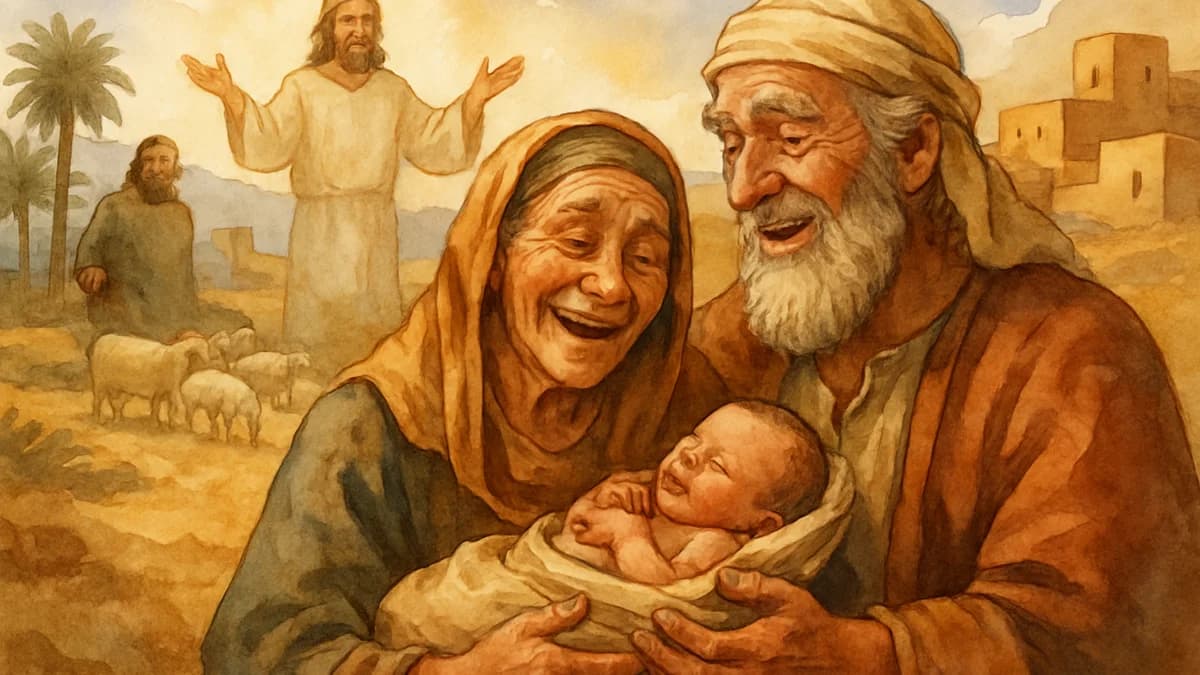
The Birth of Isaac
God Keeps His Impossible Promise
Genesis 21:1–7God had made an extraordinary promise to Abraham — that he would have a son, and through that son, millions of descendants, and through them, a blessing for the whole world.
There was one enormous problem: Abraham was old. Very old. He was one hundred years old. And his wife Sarah was ninety. She had never been able to have children, and now she was far past the age when any woman could have a baby.
But then God did what only God can do.
"The LORD visited Sarah as he had said, and the LORD did to Sarah as he had promised." At the exact time God had said, Sarah became pregnant. And she gave birth to a son.
Abraham held his newborn boy. He named him Isaac, which means "he laughs" — because when God had first told Abraham he would have a son at his age, Abraham had laughed. And when Sarah had overheard the same news, she had laughed too.
Sarah said, "God has brought me laughter. Everyone who hears about this will laugh with me. Who would have said to Abraham that Sarah would nurse children? Yet I have given him a son in his old age."
The whole thing was impossible by human standards. And that was exactly the point.
God did not wait for Abraham and Sarah to get young enough or strong enough. He waited until it was completely impossible by human ability — so that when Isaac was born, no one could doubt: only God did this.
Isaac was a miracle. Every time someone saw him, every time he grew an inch, every time Sarah nursed him, they were seeing a living reminder that God keeps his promises and that nothing is too hard for him.
The long wait was over. The promise had begun to come true.
Christ in This Story
Galatians 4:28 calls Christians "children of promise, like Isaac." Just as Isaac was born not by human effort or natural possibility, but by God's word and power alone, so Christians are born again "not of blood nor of the will of the flesh nor of the will of man, but of God" (John 1:13). The new birth — becoming a child of God — is just as miraculous as Isaac's birth. Jesus himself told Nicodemus that you must be "born again" — born from above, by the Spirit of God, not by your own effort.
Historical Context
In the ancient Near East, having children — especially sons — was considered an absolute necessity. A childless couple was often seen as cursed or forgotten by the gods. Sarah's inability to have children would have been a source of deep shame and grief. The fact that God chose a barren woman to bring forth his promise is part of his pattern: God loves to show his power through human impossibility, so the glory goes to him and not to human strength.
Isaac's name (meaning "he laughs") is a beautiful touch — it captures the disbelief that turned to joy. The entire story of Abraham is a story of improbable faith meeting faithful God.
✦ This story also appears in the Quran
For parents: This biblical account has a parallel in the Quran (Islam's holy book), but the two versions differ in important ways. The Quran retells many Old and New Testament stories — sometimes similarly, sometimes with significant changes in detail, meaning, or theology.
This is a great opportunity to help your children know the biblical account well, so they can recognize differences if they ever encounter them. The Bible is our authoritative source; where the Quran diverges, we hold to what God's Word says.
Let's Pray
God, nothing is too hard for you. When things seem impossible in our lives, help us to remember Sarah laughing with joy, and to trust that you keep every promise you make. Amen.