God's Covenant with Abraham
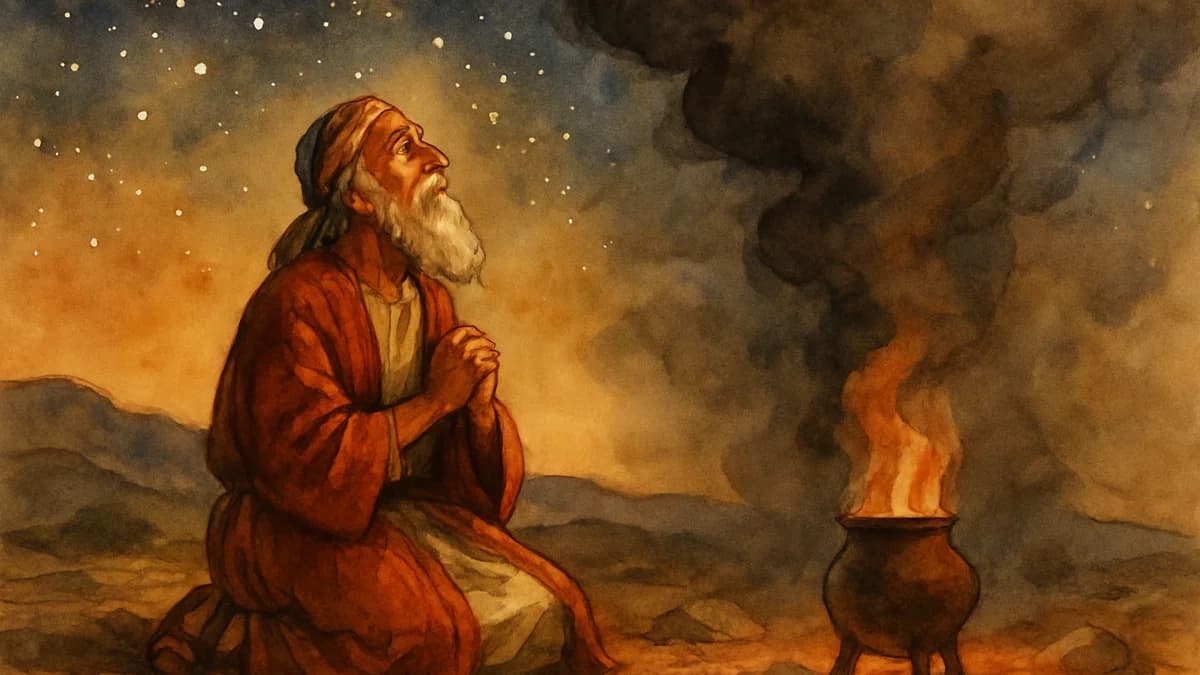
Stars, Darkness, and the Smoking Firepot
Genesis 15:1–21Years had passed since God called Abram to leave Ur. Abram had followed God faithfully. But he still had no son. The promise seemed impossible.
God came to Abram in a vision: "Do not be afraid, Abram. I am your shield and your very great reward."
But Abram was honest. "Lord God, what can you give me if I remain childless? The only heir of my household is a servant."
God took Abram outside into the dark night and said: "Look up at the sky and count the stars — if you can count them. That is how many descendants you will have."
Abram looked up. The stars were beyond counting — like scattered handfuls of silver dust across the darkness.
And Abram believed God.
That one sentence changed everything: he believed God. The Creator of all those stars had made a promise. And Abram trusted him.
Then God said something even bigger: "I am the LORD who brought you out of Ur of the Chaldeans to give you this land to take possession of."
Abram asked, "Lord God, how can I know that I will actually possess it?"
God said, "Bring me a heifer, a goat, a ram, a turtledove, and a pigeon." Abram brought them, cut them in half, and laid the pieces in two rows with a path down the middle. This was how covenants were made in the ancient world. Both parties would walk between the cut animals, meaning: "If I break this promise, may what happened to these animals happen to me."
Abram waited. The sun set. Deep darkness fell.
Then a smoking firepot and a blazing torch appeared — signs of God's holy presence — and they passed between the pieces. Alone. Only God walked through.
God bound himself to the promise. If the covenant was broken, only God would bear the consequences. This was pure grace — an unconditional, unbreakable promise.
God said to Abram, "To your descendants I give this land."
The deal was done. God had staked himself on it.
Christ in This Story
This covenant is the most stunning picture of grace in the entire Old Testament. Normally both parties walked between the pieces. Here, only God walks through — meaning God takes the full weight of the covenant on himself. If it breaks, God bears the penalty. And that is exactly what happened on the cross: Adam and Eve, Abraham's children, all of us — we broke the covenant. And God himself, in the person of Jesus, bore the penalty. The blazing torch passed between those pieces was, in a sense, already walking toward Calvary.
Historical Context
The covenant-making ritual in Genesis 15 — cutting animals in half and walking between them — is confirmed by ancient Near Eastern documents. Jeremiah 34:18 references this exact practice. By walking through the pieces alone, God was taking a divine oath: "I swear by myself." This is the most solemn form of promise in the ancient world.
Verse 6 — "Abram believed the LORD, and he credited it to him as righteousness" — is one of the most quoted verses in the New Testament. Paul cites it in Romans 4 and Galatians 3 as the foundation for justification by faith. Abraham was made right with God not by doing religious rituals, but by trusting God's promise.
✦ This story also appears in the Quran
For parents: This biblical account has a parallel in the Quran (Islam's holy book), but the two versions differ in important ways. The Quran retells many Old and New Testament stories — sometimes similarly, sometimes with significant changes in detail, meaning, or theology.
This is a great opportunity to help your children know the biblical account well, so they can recognize differences if they ever encounter them. The Bible is our authoritative source; where the Quran diverges, we hold to what God's Word says.
Let's Pray
God, thank you that your promises are not based on our faithfulness but on yours. You always keep your word. Help us to trust you like Abraham did — even with the things that seem impossible. Amen.