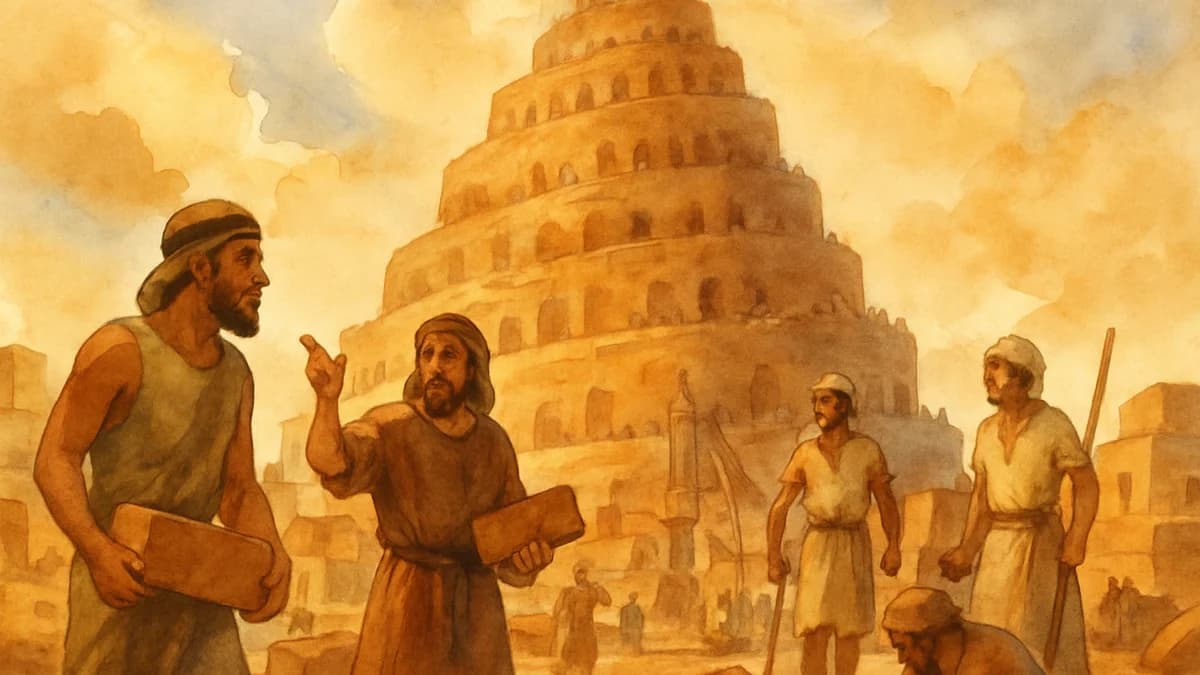
The Tower of Babel
When People Tried to Reach Heaven on Their Own
Genesis 11:1–9After the flood, Noah's children and grandchildren spread out and filled the earth. For a while, everyone spoke the same language.
The people settled on a wide, flat plain in the land of Shinar — which is in modern-day Iraq. And they had a plan.
"Come," they said to each other, "let us build ourselves a city with a tower that reaches to the heavens. Let us make a name for ourselves, or we will be scattered over the whole earth."
They made bricks and burned them hard. They started building — higher and higher, the tower climbing toward the sky.
But notice what they said: "Let us make a name for ourselves." They were not building for God. They were not building to honor him. They wanted to be great on their own. They wanted to be safe — to stay together — on their own terms, not God's.
God came down to see the city and the tower. He was not worried that they would actually reach heaven. He saw something more dangerous: if nothing stops them, they will do anything they think up. Pride is like that — it grows and grows until it has no limits.
So God confused their language.
Suddenly, no one could understand anyone else. The builders couldn't give instructions or ask for materials. The whole project fell apart. People who spoke the same new language gathered together and moved away. The great project was abandoned.
The city was called Babel — which sounds like the Hebrew word for "confused."
And the very thing they feared — being scattered — happened.
When people try to build their way to greatness without God, it never ends well. True greatness comes from knowing the God who made us, not from building things to show how great we are.
Christ in This Story
Babel is the story of humanity trying to reach God by their own effort — their own bricks, their own tower, their own strength. It failed. Jesus is the answer to Babel. In John 1:51, Jesus tells Nathanael, "You will see heaven opened and the angels of God ascending and descending on the Son of Man" — language that echoes Jacob's ladder in Genesis 28. Jesus is the true ladder, the true tower, the real bridge between heaven and earth. And at Pentecost in Acts 2, God reverses Babel: people from every language hear the gospel in their own tongue — God undoing the confusion and gathering scattered people back to himself through the Holy Spirit.
Historical Context
The plain of Shinar is ancient Mesopotamia — modern southern Iraq, the same region where Babylon was later built. The great ziggurats (stepped temple towers) of ancient Babylon were massive structures built to honor their gods and were visible for miles. Some scholars believe the Tower of Babel story is connected to these ziggurats — temples built to bridge the gap between earth and heaven. The Babylonians believed their city was the center of the universe and called it "Bab-ilu," meaning "Gate of God." Genesis tells a very different story about what that project really was.
Let's Pray
God, forgive us for the times we try to make ourselves great without you. Remind us that you are the one who made us, and that living with you is greater than anything we could build on our own. Amen.