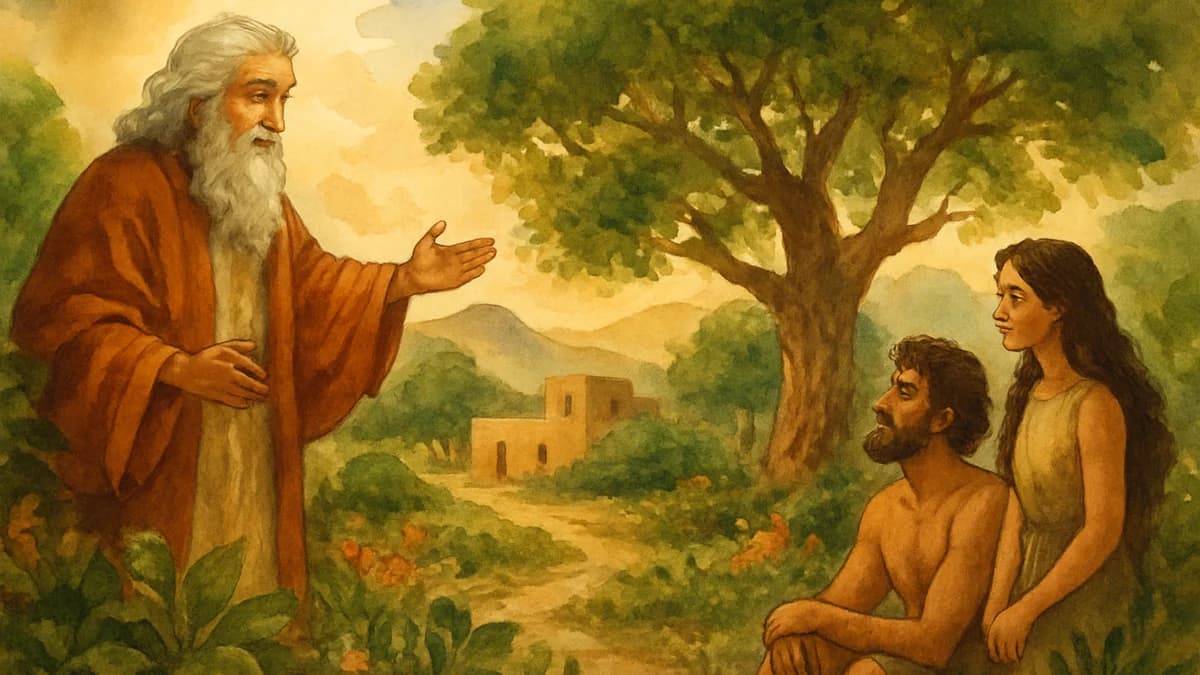
The Garden of Eden
God Plants a Home for His People
Genesis 2:4–25God did not just create the world and walk away. He planted a garden — a special, beautiful home — for the people he had made.
The Garden of Eden was full of life. Every kind of fruit-bearing tree grew there, loaded with food. A river flowed out of the garden and split into four great rivers, watering the whole land. Gold and precious stones sparkled in the ground. It was a perfect place.
God put Adam in the garden with a job: to work it and take care of it. This was not hard, miserable labor — it was joyful work, like a child helping in a parent's garden. Adam was steward over God's world.
God said only one thing was not allowed: "Do not eat from the tree of the knowledge of good and evil. If you eat from it, you will surely die."
Then God said something that changed everything: "It is not good for the man to be alone."
God brought every animal and bird to Adam, and Adam named them — showing his authority over creation. But among all the creatures, there was no one like Adam. No one who could share his life, think his thoughts, carry his heart.
So God caused Adam to fall into a deep sleep. He took a rib from Adam's side and shaped it into a woman. When Adam woke and saw her, he cried out with joy: "This at last is bone of my bones and flesh of my flesh!" He called her Woman, because she was taken from Man.
Adam and Eve were together in the garden, with no shame, no fear, no hiding. They walked freely with God. It was the world as God designed it — humans with their Creator, at home, at peace, at work.
Christ in This Story
The garden is the pattern for everything God is working toward in the whole Bible. The last two chapters of Revelation describe God's restored creation as a garden-city where God dwells with his people, the river of life flows from his throne, and the tree of life grows on both banks. Jesus is bringing his people back to what Adam and Eve had — and something even greater. John 1:14 says Jesus "tabernacled among us" — he moved into our neighborhood, making himself at home with us, just as God walked with Adam and Eve in the garden.
Historical Context
The rivers mentioned in Genesis 2 include the Tigris and Euphrates, which are real rivers in modern-day Iraq. Scholars have long placed the Garden of Eden somewhere in the ancient Near East, though the flood of Noah likely changed the geography dramatically. The Hebrews reading this story would recognize these rivers as real — this was not a myth set in a fantasy land, but real history in a real place.
The Hebrew word for "Adam" simply means "man" or "human." The woman is later named "Eve," meaning "living" or "life-giver." Both names carry deep meaning — they are not just individuals but the heads of the entire human race.
✦ This story also appears in the Quran
For parents: This biblical account has a parallel in the Quran (Islam's holy book), but the two versions differ in important ways. The Quran retells many Old and New Testament stories — sometimes similarly, sometimes with significant changes in detail, meaning, or theology.
This is a great opportunity to help your children know the biblical account well, so they can recognize differences if they ever encounter them. The Bible is our authoritative source; where the Quran diverges, we hold to what God's Word says.
Let's Pray
Thank you, God, for making us to be with you. Thank you that you don't leave us alone. Help us to know that you are always near. Amen.